
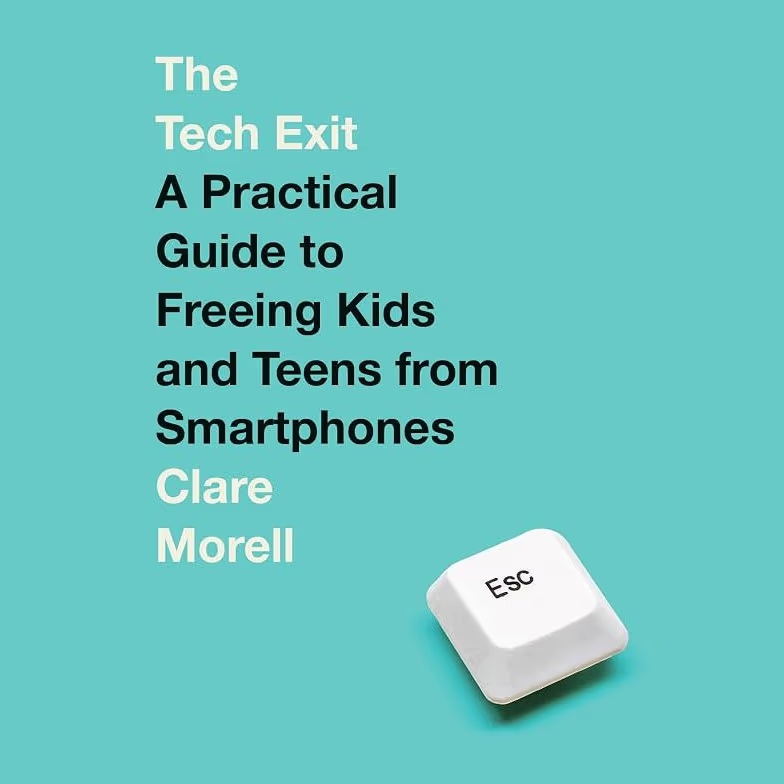
Recently I listened to a Morning Wire podcast interview with Clare Morell, who has written a book called The Tech Exit: A Practical Guide to Freeing Kids and Teens from Smartphones. Mrs. Morell is a fellow at the Ethics and Public Policy Center; she worked in the White House Counsel’s office and for the Department of Justice, and has written many articles and opinion pieces which can be found here at Clare Morell.
Her book spells out the many benefits of going completely against the prevailing culture and protecting children from phones, social media, and other tech while they are still children. In a column she posted a little over a year ago, she wrote:
“...when boredom strikes and parents are busy, screen time becomes an alluring, if not irresistible, default. Even as awareness grows about the risks and harms of smartphones and digital tech for kids, many of us still feel it is nearly impossible to keep screens from dominating long summer days. So, we hand over the tablet or say yes to more phone time — all while ignoring a nagging sense of guilt. We feel stuck.
That’s why I wrote The Tech Exit — to help parents break free from the screen-time trap. As a tech policy expert, I had seen evidence firsthand: half-measures like screen time limits and parental controls are largely ineffective at protecting kids from online harms. And as a mom, my husband and I decided not simply to limit our children’s access to digital tech, but to remove it from childhood entirely, except for shared family screen time for movies. We committed to not give smartphones, tablets, or social media to our kids. But at the time all three of them were under age four, and I was unsure if I could really keep this commitment even through the teen years. I needed to find out: Was this really possible? And if so, how had other parents done it?
I spent the last three years talking to families around the country who have fully opted out of digital technology for their kids, including saying no to smartphones and social media through the end of high school. What I found is that it not only can be done, but it is absolutely worth it. Not a single family expressed regret. On the contrary, they describe it as one of the most important parenting decisions they have made. Their now-adult children appreciate it too, even if they didn’t love the restrictions at the time. For those who are intrigued, you can follow in their footsteps to find this same freedom from tech.”
Geneva parents are already sailing against prevailing winds by providing a real education that will make their children into thinkers and leaders. Geneva parents are investing in the future of their sons and daughters. Yet how many of us keep a channel to our children’s minds open, via unsupervised social media or games or apps, through which comes a stream of foolish, dangerous, or witless content? Material at odds with the truth, beauty, and goodness they’re learning at school and church?
(Of course, there are very helpful online educational programs and valuable videos on gardening, cooking, woodworking, sewing, making repairs, etc. I think Mrs. Morell would assert that there are other ways, besides personal digital tech, to gain needed information about worthy pursuits, and such programming might fit into the week’s family screen time.)
As a first step, Clare Morell suggests a 30 day digital detox. She writes:
“It sounds daunting, but detoxes work. In one recent study, adults who blocked internet access on their phones for just two-weeks reported significant improvements. In fact, 91% felt better afterward. They found they had better mental health, better subjective well-being and better sustained attention. Another study of young adults found that a two-week detox from social media resulted in “improved smartphone and social media addiction, as well as sleep, satisfaction with life, stress, perceived wellness, and supportive relationships.”
Psychiatrist Dr. Victoria Dunckley, author of Reset Your Child’s Brain, has used screen detoxes with patients facing conditions like ADHD or autism. She found that removing all screens substantially reduced symptoms and behavioral issues. Of the over 500 children and teens who have done her detox, 80% with a diagnosed psychiatric disorder saw at least a 50% reduction in symptoms. In some cases, symptoms like tantrums and poor focus entirely disappeared.”
So, as a new school year begins, I encourage parents to examine the digital lives of their children carefully, and consider a digital detox, or even better, a tech exit altogether. It will be easier if more families do it together!
Mrs. Morell’s tech exit checklist can be found here: The Tech Exit Checklist.
I will end with David’s determination in Psalm 101:3:
“I will not set before my eyes anything that is worthless.” (ESV)
Brian R. Turner
Head of School