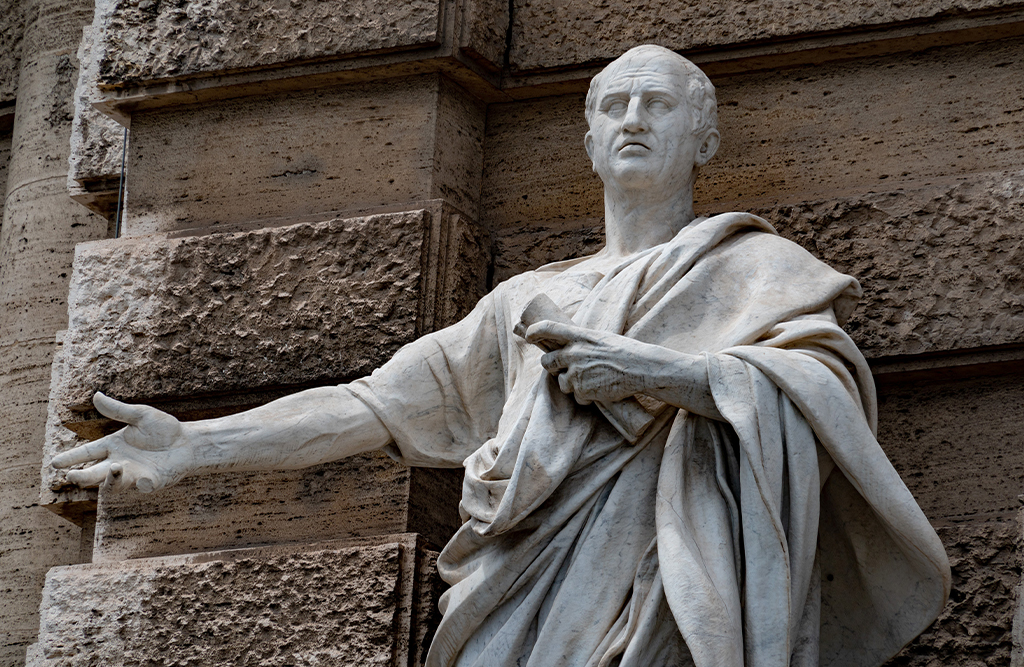
“Read at every wait; read at all hours; read within leisure; read in times of labor; read as one goes in; read as one goest out. The task of the educated mind is simply put: read to lead.” – Cicero
Have you heard of Cicero? Maybe vaguely as a famous Roman orator? He lived at the time of Julius Caesar, and lamented in tremendous speeches the loss of the old Republic and its ways, and the onset of an empire. He wrote so well, and his books were so influential, that at least one famous historian has said that it was the re-discovery of Cicero’s writings alone (by Plutarch) that led to the Renaissance in Italy.
Cicero led a very interesting life in the spotlight, and his life came to an abrupt end when trying to escape arrest by the forces of Octavian and Mark Antony. Cicero had spoken out against both of them. He was captured and executed. In Roman fashion, his head and hands were cut off and taken to Rome where they were put on display on the speaker’s rostra in the Forum.
He was a little over 60 when he died. At just 21, he wrote a brilliant book about rhetoric called De Inventione. The 10th graders and I just read the first pages of it as our introduction to Rhetoric II. Cicero starts off the book by explaining his frequent pondering of this question: “Has eloquence been beneficial or injurious to men and cities?”
Cicero had studied history and knew that disasters and calamities had resulted in the Roman Republic, and other important states, from influential men that did awful things. Yet, he also, from his historical studies, found that “many cities have been established, many wars extinguished, many most enduring alliances and most holy friendships have been cemented by deliberate wisdom much assisted and facilitated by eloquence.”
The result of these two sides of the issue boiled down to the following: when a person perfects his eloquence in the absence of wisdom, he is going to be “useless” to himself and mischievous to his country. However, if a man “arms himself” with eloquence while learning wisdom and virtue at the same time, he will be both a man and a citizen of the greatest service to himself and his country.
Later in the introduction, Cicero says a man of wisdom, trained in excellence, ought not shrink away from speaking out and opposing evil, even if it costs him his life. He said it is often when most needed that the virtuous retreat to a tranquil, private life. Some 40 years later he paid the cost for living by his principles.
I think it’s very good for our Geneva students to themselves think about why someone ought to be eloquent, and why wisdom must accompany eloquence. This has great implications for Christians. It is often the lack of gracious and simple and clever ways of speaking that renders
Christian viewpoints as narrow or bigoted or offensive. We ought to develop our communication skills so as to be better servants to Christ our Lord and His church. It will also help us serve our work and community and nation better.
A closing thought is tied into Cicero’s quote at the top of this column. If one replaced the word “read” with the word “scroll,” one would find the quote absurd. No one says, “Scroll to read.” We’re on our phones too much, and we’re training our children to do the same. We need to read more. Let that be your encouragement: Read more! And encourage wisdom and eloquence together.
Thank you all for a very, very good first week back at School!
Brian Turner
Head of School