Most Christians I’ve known (including myself!) grew up ignorant of church history and the rich heritage that is ours. Many Protestant Christians are under the vague impression that somewhere a few hundred years ago evangelicals, Methodists, Baptists, Presbyterians, etc. just appeared on the scene. This mistaken concept is known as “the cut flower view”… as one might look at a flower without considering the leaves and roots from which it sprung. Protestantism was an effort to recover the practices and doctrines the church held for centuries after Christ walked the earth. Similarly, many Catholics don’t realize that reformers like Martin Luther and John Calvin were part of a very long line of church reformers. There were many individuals, and whole orders established, that emphasized a return to holiness, piety, and New Testament simplicity. Reformers like Girolamo Savonarola were thoroughly Catholic in their orientation.
Our wonderful Geneva Academy community is made up of Christians from many different churches, and we can all benefit from glancing back in time to amazing and faithful servants of God. In prior years, we celebrated All Saints’ Day by looking St. Patrick and St. Athanasius. This year, we will consider St. Augustine of Hippo.
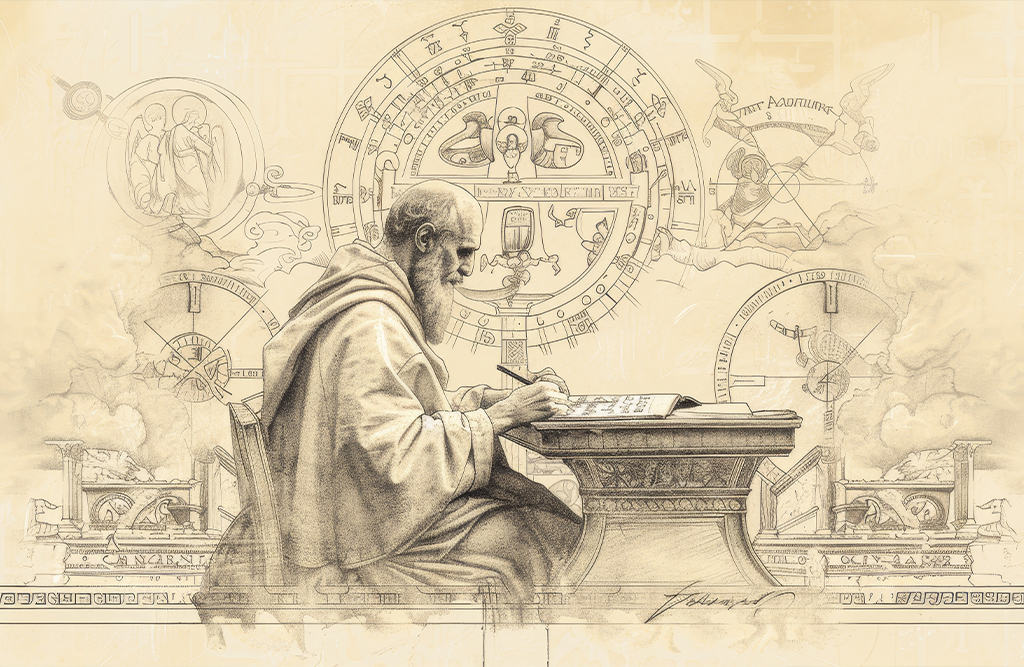
St. Augustine was born in 354 AD to a Christian mother and a pagan father. (The father converted to Christianity on his deathbed). Augustine was a bright student and was sent to get a classical education, excelling in grammar and rhetoric. He fell under the spell of Manichaeism, which was based on the teachings of a 3rd century Iranian teacher named Mani. Manichaeism was a combination of Babylonian religions, Christianity, Plato’s teaching, and a grab bag of other ideas. Augustine’s mother never ceased praying for the conversion of her son.
As a young man Augustine traveled to Milan, Italy, where he was employed for his brilliant rhetorical skills. He came under the teachings of the famous Bishop of Milan, Ambrose. (Ambrose would make a great subject of a future All Saints’ Day celebration!). Ambrose, and other smart, Christian friends, helped Augustine see who Christ really was. Augustine became a Christian and soon after began his ministry.
Augustine was ordained a priest in 391 and a Bishop five years later. He wrote over 100 books on philosophy and theology. History has also preserved 600 of his sermons, and 300 of his letters. His two most famous works are The Confessions and The City of God. Geneva students read these books!
Augustine’s thoughtful and provocative writings influenced the church greatly, and really helped steer the entire course of Western Civilization. For someone who told fellow Christians that Rome was not our true home, and that happiness can only be found through membership in the heavenly City of God, he had a remarkable impact on the beliefs and practices of nations and peoples in the west.
Our students on Friday will be learning about Augustine. It will be a fun day, for we mix in stories and art and movement. Parents are invited to drop in at any time! (We could also use some help with our Roman lunch. Please contact Mr. Harmon if you can assist.)
As we learn about an extraordinary saint, and remember also the many ordinary saints we are indebted to, I hope there will be a sweet fellowship at the school. We are all on a special road together:
A highway shall be there, and a road,
And it shall be called the Highway of Holiness.
The unclean shall not pass over it,
But it shall be for others.
Whoever walks the road, although a fool,
Shall not go astray.
9 No lion shall be there,
Nor shall any ravenous beast go up on it;
It shall not be found there.
But the redeemed shall walk there,
10 And the ransomed of the Lord shall return,
And come to Zion with singing,
With everlasting joy on their heads.
They shall obtain joy and gladness,
And sorrow and sighing shall flee away.
Isaiah 35:8-10 (NKJV)
May the grace of the Lord rest upon your family!
Brian Turner
Head of School